
The Magnificent McHenry House Part 2 – Departures and Demises
published on March 5, 2017
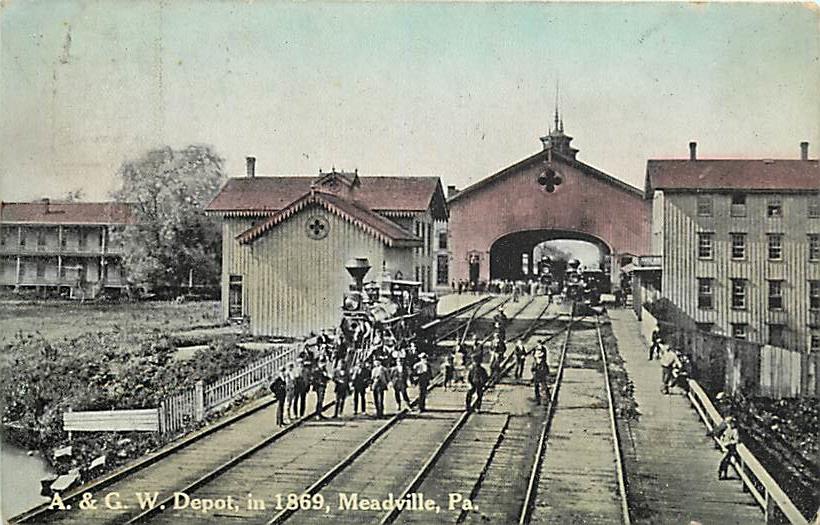 |
| A & GW Depot with McHenry House to the left in 1869 |
As with most establishments in the hospitality industry, success could not have been attained without competent management. The same holds true for the McHenry House, which appears to owe much of its heralded reputation to Superintendent, R. M. N. Taylor. (Mentioned in Part 1 of this series) Taylor had previously managed the Angier House in Cleveland, Ohio before being recruited away to Meadville. Given the accolades he would earn during his tenure at the McHenry, it proved to be a fortuitous move for all parties.
“It may be expected that I should say something in reply but this is so unexpected and at the same time so gratifying that I assure you we have no words to express properly our acknowledgement. We are indeed overwhelmed by the mark of confidence and esteem. We can never outlive the remembrance of this occasion, and can only say–we thank you.”
John Wilkes Booth
 |
| John Wilkes Booth |
Taylor also played a part in one of the McHenry House’s more peculiar tales, this one involving the assassin, John Wilkes Booth. Booth’s presence in Meadville would have been by no means an oddity. In early 1864, Booth, along with partners from Cleveland, formed the Dramatic Oil Company and purchased land near Franklin in the hopes of striking it rich. While the venture would ultimately prove to be a failure, Booth made several trips to the area from January to September which included confirmed stays at the McHenry House on June 10th and 20th.
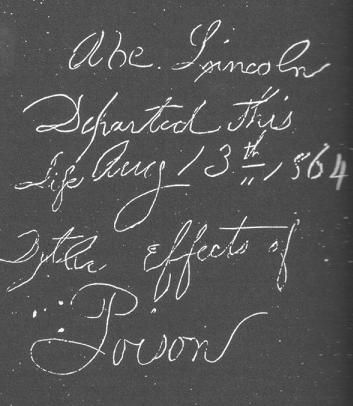 |
| The inscription on the window |
The truth of Booth’s culpability regarding the window has never been substantiated, leaving the matter open for speculation. A comparison of Booth’s handwriting and that on the window was deemed a consistent match, while the mention of poison merits credibility with many given Booth’s close association with David Herold, a druggist’s clerk with easy access to such means. A previous attempt to kill the President using poison can further be supported based on a letter by one of the conspirators referencing how “the cup had failed us and could again.”
Fire and Demise
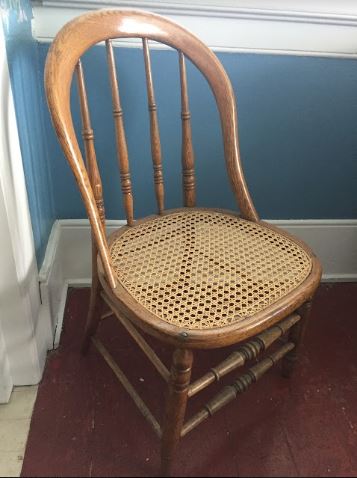 |
| A McHenry House chair at the Baldwin Reynolds |
The rising number of travelers following the Civil War combined with the McHenry House’s success, demanded expansion, and a new, three-story wing measuring 125 x 30 feet was constructed in December of 1865 just in time for Taylor’s return to Cleveland. The popular manager’s departure at the height of the McHenry House’s popularity seemed an odd contrast of circumstances, and may have been an indicator of the hotel’s future.
Conclusion
Miss Part 1 of this series? Go Here.
Sources
Stewart, Anne. Moore, William. Images of America: Meadville, Arcadia Publishing, Charleston, SC. 2001
Ilisevich, Robert. Remembering Crawford County, Pennsylvania’s Last Frontier. The History Press. Charleston, SC. 2008
Reynolds, William. (editors) Gifford, Peter. Ilisevich, Robert. European Capital, British Iron, and American Dream: The Story of the Atlantic and Great Western Railroad. University of Akron Press, Akron, OH. 2002
Reynolds, John Earle. In French Creek Valley. The Tribune Publishing Company, Meadville, PA. 1938
Miller, Ernest C. John Wilkes Booth, Oilman. Exposition Press, New York, NY. 1947
Cleveland Daily Leader, 1863 – 1866
The Crawford Democrat, 1863 – 1865
New York Tribune, 1864
Democrat and Chronicle, 1880
Pittsburgh Daily Post, 1879
Syracuse Daily Courier and Union, 1865
The Brooklyn Daily Eagle, 1864
The Record Argus, 1876 – 1881
Western Reserve Chronicle, 1866
About the Author

Ron Mattocks was born and raised in Guys Mills, Pennsylvania. Following high school he joined the Army to see the world (which he did) before a career as a construction executive in Texas. Eventually Ron switched to Internet marketing, consulting for companies such as GMC, ConAgra, Mattel, and others. During this time he also began writing regularly for the Huffington Post, Disney’s Babble, and the TODAY Show. On a summer visit to Conneaut Lake Park, Ron became suddenly fascinated with the park’s origins, a fascination that lead to a passion for the county’s extensive history. Today Ron is the VP of Digital Strategy Development with an agency in Indiana where he lives with his three sons. He graduated from St. Edwards University in Austin, Texas with a degree in English Literature, and is a member of both the Crawford County and Conneaut Lake Area Historical Societies.
* * *
Membership Plans for Everyone!
 |
| Join Today! |
The Crawford Messenger
Recent Articles
Dr. Alexander McLeod’s 1834 Letter on Vaccines in the Crawford Messenger [Guest Submission]

A Brief History of Politics in Crawford County
Life and Customs in Meadville, 1842
Membership Oportunities
Membership in the Crawford County Historical Society is for everyone with an interest in the rich history of Crawford County, Pennsylvania.