The Magnificent McHenry House Part 1: A City Arrives
published on February 26, 2017
 |
| A crowd gathered to greet one of the inaugural A & GW trains. Note the Depot in the background. |
As time progresses forward it becomes increasingly difficult to imagine the grand structures that once dominated the landscapes of our community. While a long list of such buildings could be compiled for Crawford County, few would compare to the magnitude and grandeur of the McHenry House and the adjoining depot of the Atlantic and Great Western Railroad in Meadville.
The Railroad Comes to Town
On October 28, 1862, the tracks of the A & GW reached Meadville; a month later the first passenger train arrived to great fanfare. The crowd of onlookers was so large the train was forced to stop at Race Street until the tracks could cleared. But the curious crowd wasn’t the only thing waiting to greet passengers, who were immediately awed as their train was swallowed whole by the depot’s full-length awning, covering the entirety of the tracks.
 |
| The McHenry House extending off the west side of the Depot |
In its entirety, the Meadville Depot extended from Center to Chestnut Streets. Officially it was listed as 327 feet long and 127 feet wide, encompassing and area of 41,520 square feet of space. Inside the depot, aside from ticketing stations and passenger waiting areas, were well-lit offices, tenements for employees, and large machine shops. Impressive in its own right, the Depot still did not account for the splendor of the McHenry House which adjoined the Depot on the western side.
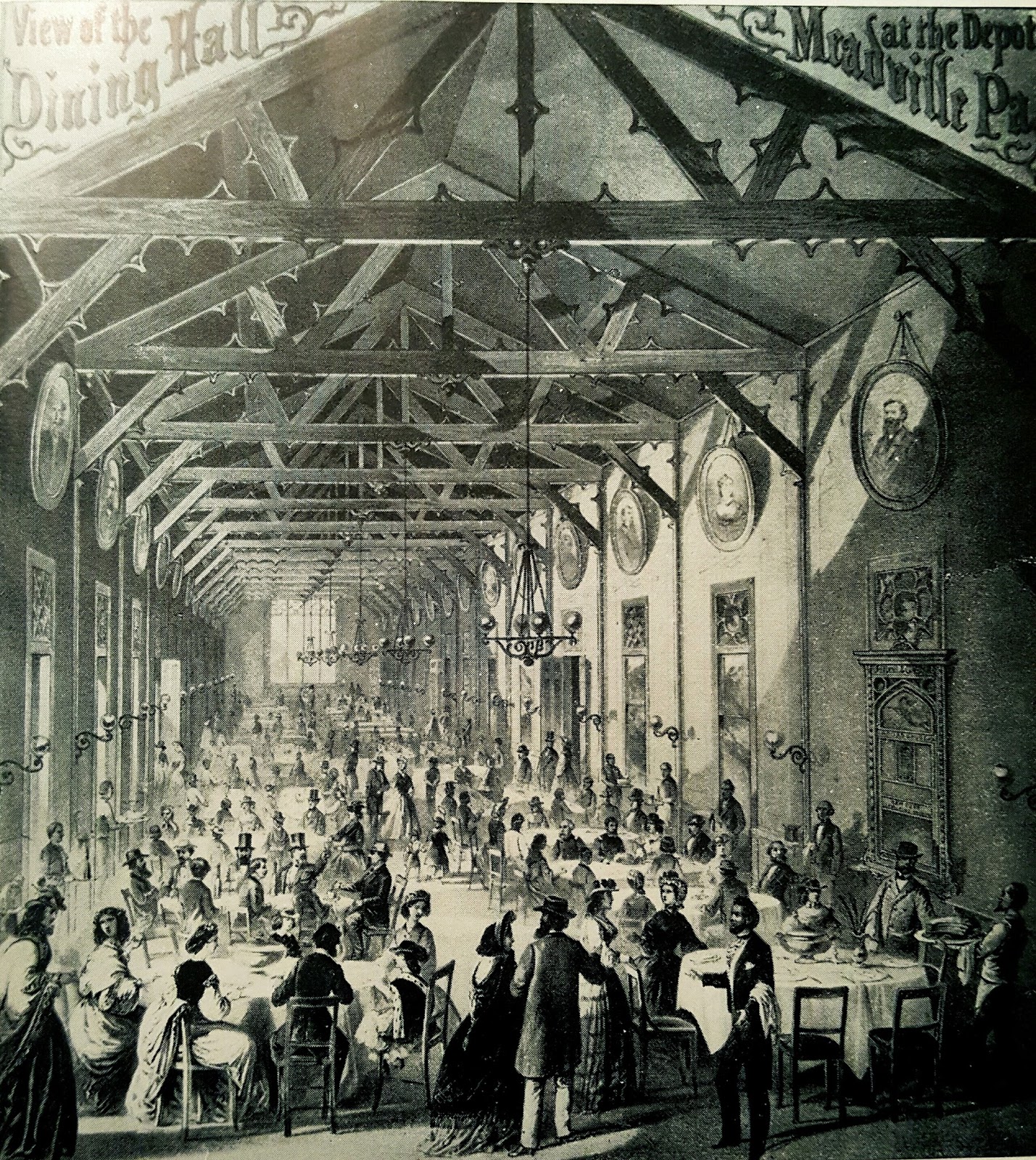 |
| The Dinning Hall at the McHenry House |
Taylor’s menu routinely comprised of 4 types of cold meats, 6 varieties of game meat, 5 entrees, 5 roasts, 8 relishes, 5 pastries, and 8 desserts. Such a fine spread earned comparisons with establishments in New York City. Famed newspaper editor, Horace Greeley took such claims a step further in a January 19th, 1864 expose of the A & GW in the New York Tribune:
Celebrating McHenry
 |
| The Depot decorated to receive McHenry and the European dignitaries |
The forces of nature, however, would delay the event after strong storms washed out bridges east of Corning, New York, forcing the European guests of honor to wait for a special train to continue their journey to Meadville. Upon their eventual arrival, Reynolds and other town officials greeted McHenry at the train and escorted him to the dining hall for a large feast followed by a firework display later that evening. The moment, however, likely meant more to Reynolds than it did anyone. It was his vision and persistence that prevailed despite a number of difficulties, not the least of which was the ongoing friction between him and these same European partners.
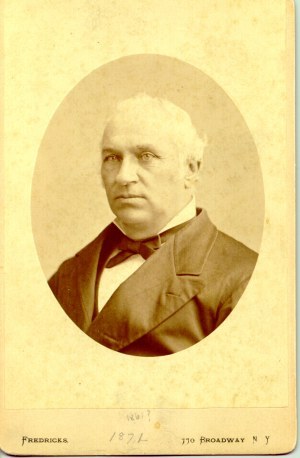 |
| William Reynolds |
Reynolds’ feelings seem apparent in the cordial yet tepid tone by which he introduced McHenry and the European contingent that evening. In the end, however, his objective had been met, and whether the McHenry House had been named so out of obligatory courtesy or the insistence of the European contingent is unknown. To the residents of Meadville, such turbulent political undercurrents were irrelevant in comparison to the resulting prosperity the railroad brought to the area.
Indeed, the McHenry House and depot were more than a mere building. Meadville was now recognized as the most important stop along the A & GW line, and as the Cleveland Daily Leader remarked, “few inland towns [have] so steady and substantial trade,” as Meadville. Such economic stability was further buoyed by its increasing population which surged from 3,000 to over 5,000 in only a few short years, a period referred to as the “material second growth” of Meadville.
COMING NEXT – The Magnificent McHenry House Part 2: Departures and Demise
The future of the McHenry House would flourish under the direction of a beloved manager, and it would become a source of speculation in the wake of a president’s assassination. Read it Here.
Sources:
Published Works
Stewart, Anne. Moore, William. Images of America: Meadville, Arcadia Publishing, Charleston, SC. 2001
Ilisevich, Robert. Remembering Crawford County, Pennsylvania’s Last Frontier. The History Press. Charleston, SC. 2008
Reynolds, William. (editors) Gifford, Peter. Ilisevich, Robert. European Capital, British Iron, and American Dream: The Story of the Atlantic and Great Western Railroad. University of Akron Press, Akron, OH. 2002
Reynolds, John Earle. In French Creek Valley. The Tribune Publishing Company, Meadville, PA. 1938
Miller, Ernest C. John Wilkes Booth, Oilman. Exposition Press, New York, NY. 1947
Cleveland Daily Leader, 1863 – 1866
The Crawford Democrat, 1863 – 1865
New York Tribune, 1864
Democrat and Chronicle, 1880
Pittsburgh Daily Post, 1879
Syracuse Daily Courier and Union, 1865
The Brooklyn Daily Eagle, 1864
The Record Argus, 1876 – 1881
Western Reserve Chronicle, 1866
About the Author

Ron Mattocks was born and raised in Guys Mills, Pennsylvania. Following high school he joined the Army to see the world (which he did) before a career as a construction executive in Texas. Eventually Ron switched to Internet marketing, consulting for companies such as GMC, ConAgra, Mattel, and others. During this time he also began writing regularly for the Huffington Post, Disney’s Babble, and the TODAY Show. On a summer visit to Conneaut Lake Park, Ron became suddenly fascinated with the park’s origins, a fascination that lead to a passion for the county’s extensive history. Today Ron is the VP of Digital Strategy Development with an agency in Indiana where he lives with his three sons. He graduated from St. Edwards University in Austin, Texas with a degree in English Literature, and is a member of both the Crawford County and Conneaut Lake Area Historical Societies.
* * *
Membership Plans for Everyone!
 |
| Join Today! |
The Crawford Messenger
Recent Articles
Dr. Alexander McLeod’s 1834 Letter on Vaccines in the Crawford Messenger [Guest Submission]
A Brief History of Politics in Crawford County
Life and Customs in Meadville, 1842
Membership Oportunities
Membership in the Crawford County Historical Society is for everyone with an interest in the rich history of Crawford County, Pennsylvania.